# Enabling Disclosure: Reproduction Guide for the G-ynthetic Ecosystem
This document serves as the bridging technical guide required to reproduce the core functionality of the G-ynthetic Engine and its associated subsystems. This disclosure is intended to be **enabling** for individuals with sufficient skill in AI architecture, spatial computing, and system design.
## 1. Core Architectural Pillars
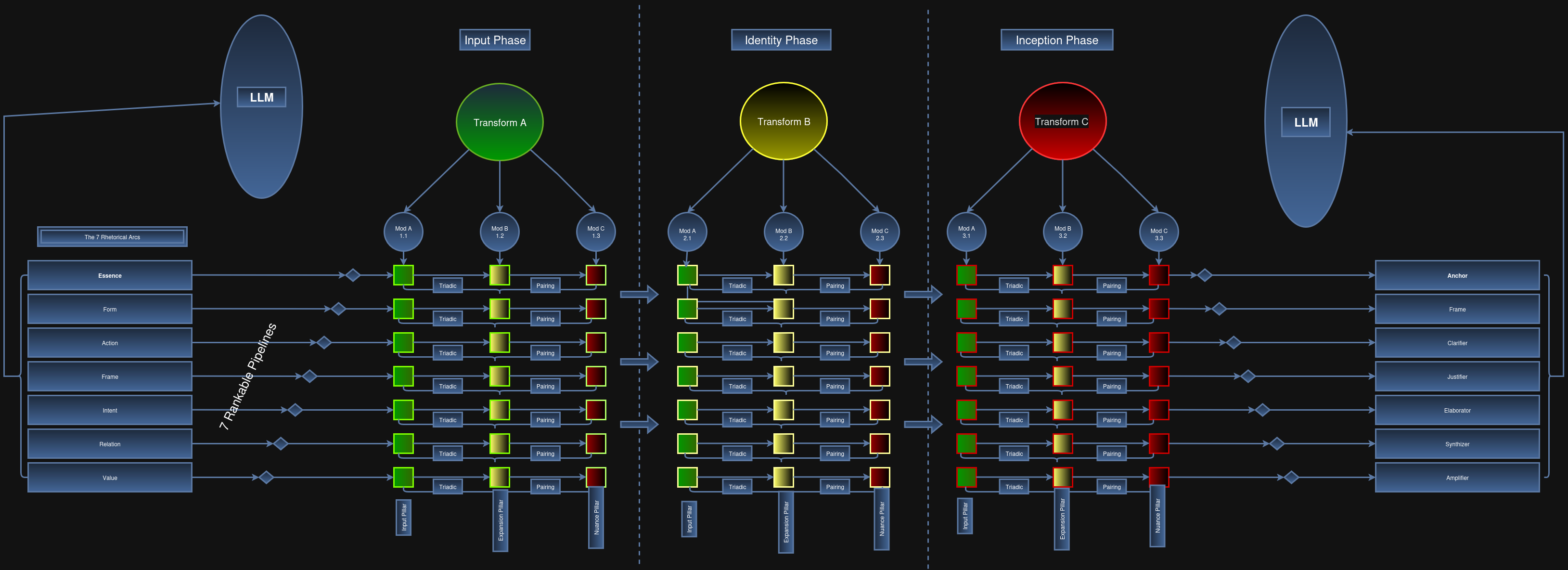
The G-ynthetic ecosystem relies on three integrated layers:
1. **G-ynthetic Engine**: The cognitive core focusing on high-density decomposition.
2. **Memory Lattice**: A 7x7x7 holographic voxel grid for non-linear state management.
3. **Affinity Simulation**: A state propagation kernel for emergent social dynamics.
## 2. Reproduction of the G-ynthetic Engine
### A. 7-Arc Decomposition
The input phase requires collapsing unstructured user prompts into 7 canonical rhetorical arcs:
- **Essence / Form / Action / Frame / Intent / Relation / Value**
- **Implementation**: Utilize an LLM (e.g., GPT-4 or Gemini) with a system prompt that enforces strict JSON output of these 7 keys. See `gynthetic_engine/intake/decomposition_engine.py`.
### B. Triadic Processing

Once decomposed, the arcs must be processed through the "Temporal Triadic" logic:
- **Risk / Reward / Relation** roles are mapped across 3 phases (Input/Identity/Inception).
- **Scoring**: Permutate all 6 possible mappings to find the highest semantic resonance.
- **Logic**: See logic in `gynthetic_engine/triadic_evaluator.py`.
## 3. Reproduction of the Memory Lattice (7x7x7)
### A. Spatial-Temporal Encoding
Instead of linear token history, memories are stored as coordinates `(t, x, y, z)` in a 343-node block.
- **Key Generation**: `key = f"T{t}-D{dx}{dy}{dz}-S{shell}"`
- **Shell Depth**: `r = max(abs(x), abs(y), abs(z))` determines priority/access depth.
### B. Retrieval (Quantum Slicing)
- To retrieve context, "slice" through a specific axis (e.g., the Y-axis for "Identity") using cosine similarity scores from your vector embeddings (768-dim recommended).
- **Ref**: `Memory/memoryLatticeService.ts` for spatial indexing logic.
## 4. System Integration
1. **Input**: User prompt is decomposed into Arcs.
2. **Mapping**: Arcs are assigned to the Lattice as new Voxels at specific coordinates.
3. **Processing**: The Engine runs a Triadic Evaluation on current context vs. retrieved lattice slices.
4. **Simulation**: The result is pushed to the `affinity_kernel.py` to propagate state changes across the 4-layer hierarchy.
## 5. Dependencies & Environment
- **Language**: Python 3.10+, TypeScript 4.5+
- **Hardware**: Coral Edge TPU recommended for real-time relevance scoring (cosine similarity).
- **API**: OpenAI API (for decomposition) and custom Vector API for lattice embeddings.
---
**PUBLIC DISCLOSURE: DEFENSIBLE PRIOR ART**
*This document, paired with the unsealed source code in the [DEEP TECHNICAL ARCHIVE](docs.html#deep-archive), constitutes a complete G-YNTHETIC technical disclosure.*